Roy and Niels

Roy and Niels
Showing posts with label antiprotons. Show all posts

Friday, July 1, 2011

Antiproton Radiotherapy Experiments at CERN

In this moment we have a week of antiproton beam at CERN for radiobiology and dosimetry experiments. The main experiment is to measure the relative biological effectiveness (RBE) of antiprotons. As an endpoint we use clonogenic survival of V79 Chinese hamster cells (in vitro).

What makes this experiment so complicated, is :
  • we only have narrow beam geometry available at CERN
  • antiprotons are rare, we only get app. 1 Gy / hour
  • beam is highly pulsed, i.e. a 500 nanosecond spill every 90 seconds.
Therefore, we invest a lot of effort in performing precise dosimetry with multiple redundant systems. This is a long story, which I will tell more about another time. Here, let me just show a few pictures...

The antiproton beam line with a water phantom for dosimetry.
The entire experiment is located in an experimental zone at the antiproton decelerator (AD) at CERN. We share our zone with the AEgIS people, who want to find out if antiprotons fly up or down in the gravitational field of the earth. :)

Franz-Joachim Kaiser messing with the water phantom. Behind him the AEgIS beam line.
Three ionization chambers (ICs) are visible here, from the left to the right: a custom made "Advanced Roos" chamber, a Markus chamber and the MicroLion liquid ionization chamber. All by PTW.
Gafchromic EBT film irradiated with antiprotons. Beam spot is about 1 cm FWHM. The narrow beam geometry makes us very vulnerable to positioning errors...

... and therefore we also monitor the beam from spill to spill with a Mimotera detector.
We are usually 2-4 people on a shift. Tonight I will do the night shift with Franz-Joachim (to the left). Stefan will leave soon. Usually, I would do night shifts with Roy Keyes, but he couldn't be here this year.
I build this little box for the experiment: it interfaces the antiproton decelerator with the printer port of our data acquisition computer. No need for expensive IO cards or fancy LabView. Basically it is just some TTL logic and optocouplers. On the server side, a daemon listens to the parallel port if a new spill of antiprotons is coming in.
Once triggered, the server takes care to read out all data systems, such as beam current transformers, ionization chamber and scintillators.
Client programs, here running on the laptop to the left, can connect to the server, and change various settings of the readout procedure.

Again, this is home-brew. Earlier, the data acquisition was some libncurses based stuff, this year is the first time we had a traditional GUI for the client and a clear client/server separation. I wrote the client in C++/QT4 and compiled it for linux and win32. Stefan did a package for mac. Server is pure C, linux only. Sometimes, I think the most valuable course I had when I was a student at our Physics department in Aarhus, was a C-programming course.  (And that course was only offered once! What a shame!)

Fiona from the Belfast QUB group is in charge of the film scans, and making sure there are enough sweets for all of us.
Entire experimental zone in the AD hall, seen from above, where our non-existant counting hut would be..
A bit off topic, but just over our heads, there is a positron beam line, which delivers the positrons to the anti-hydrogen "bottle" of ATRAP. Positrons go from the right side to the left.

Me, checking up on things... :-) I think this is the 8th or 9th time I am working at the ACE experiment.
Alanine is one of the most reliable solid state dosimeters for such exotic beams such as antiprotons. Here a stack of pellets is prepared for irradiation.

Once the pellets have been irradiated with antiprotons, they are shipped for read out to our collaborators at the National Physical Laboratory (NPL) in Teddington, UK.. (The NPL serves also as a primary standard lab for radiation quantities.)


Alright then.. :/

Recursively posting this blog entry.
More pictures here.


Monday, March 14, 2011

How to Produce Antiprotons

Both Roy and I work on the AD-4/ACE project at CERN where we investigate antiprotons as candidate particles for use in cancer therapy. We have about one week of beam time every year where we conduct radiobiological and dosimetric experiments at the beam line in a very interdisciplinary team consisting of physicists, radiobiologists and radiation oncologists from more than 10 universities and university hospitals.

CERN is the only place in the world, where we have a antiproton beam at sufficiently *low* energy, that is, around 100 MeV which corresponds to a range of ~10 cm in water. The LHC is not involved in the production at all. In fact, for antiproton production only a relatively small amount of the CERN complex is used. However, the production is still very cumbersome. First a high energy proton beam must be made. This happens at the Proton Synchrotron (PS), the old workhorse of CERN. It was inaugurated by our great Dane Niels Bohr in 1959.
The proton beam is accelerated up to 26 GeV, and then dumped into a target followed by a so-called magnetic horn.

Antiproton production target.


Basically, it is an air cooled iridium target. When the beam is dumped, two protons are converted into three protons and an antiproton. During the dump a powerful current is sent along the beam axis, which generates a magnetic field, keeping as many antiprotons as possible on axis. Immediately after the target there is a “lithium lens” (a Russian invention), which tries to capture even more of the very precious antiprotons. The created antiprotons have a very high energy of several GeV and are then captured by the Antiproton Decelerator (AD). It then takes more than 80 seconds for the beam to slow down. The deceleration is actually not the time consuming issue, but rather shaping the beam, making it small and narrow, so antiprotons are not lost during the deceleration process.
This is realized using stochastic cooling. Along with electron cooling (which was invented by G.I. Budker, and is widely applied), this will remove energy from the transverse movements of the antiprotons, thereby reducing the emittance of the beam.

Yesterday (while following Dag Rune Olsens twitter account) I learned that Simon van der Meer, inventor of stochastic cooling - and winner of the Nobel Prize, died on 4 March 2011.
From our last antiproton run at CERN I have a large amount of video material of technicians working at the AD, which also demonstrates antiproton production and stochastic cooling of the resulting beam. Check out the excerpt below:


And yes, of all those computers, only one of them was running windows. :)

At 1:49 you can see the AD hall. The antiproton decelerater is under that ring of concrete. Those large coils at the far end, which can be seen at 1:54, are delay coax cables which “short circuit” the AD ring across the middle.
At 2:00 you see the bullseye of the production target and at 2:20 the 26 GeV proton beam hits the target as the antiprotons are made. These are slowed down, and the oscilloscope shows how emittance is reduced by stochastic cooling. The beam is then stepwise ramped down to 126 MeV, and cooled in between those steps. Finally the 126 MeV antiproton beam is extracted.
(I plan to produce more videos about the AD-4/ACE experiments, but currently kdenlive crashes frequently and corrupts my project files. It took me almost one entire day to edit those 4 min of video.)

Here is another video which shows the construction of the antiproton production target and the collector. The white cylindrical object behind the target is the lithium lens.


http://cdsweb.cern.ch/record/1063081

This is one of the “hottest” sites at CERN. Things are designed to require minimal human intervention. Here is a very old video of how a faulty magnet had to replaced near the production target. People have to plan each step in advance before they enter the zone.

http://cdsweb.cern.ch/record/1171261

Monday, January 31, 2011

Making Bubbles: The Particle Way

BTI BubbleTech Industries manufacture neutron detectors intended for personal dosimetry. Theses devices contain a polymer gel holding very small droplets of a superheated gas. When a neutron interacts with these superheated droplets, a phase transition happen from liquid phase to gas phase expanding the volume dramatically - a bubble appears.

The video below demonstrates how such a detector responds to a (weak) Americium-Beryllium neutron source:


The activity of the AmBe source was 2.64E+4 neutrons per second. The detectors we had were calibrated against ICRP-60 in terms of dose equivalent, according to BTI. The sensitivity of the particular detector shown in the video above was about 0.7 bubbles / µSv dose equivalent.

The detectors come with an integrated piston which repressurizes them, so they can be reused, however not indefinitely. We used our detectors rarely, and kept them refrigerated. However, after two years the encapsulation/pressurization system leaked.

The bubble detectors can be bought with varying sensitivity ranges and BTI even offers a set of detectors which are sensitive above a varying energy threshold. Deconvoluting the counts in each detector of this set will yield a coarse energy spectrum, in e.g. 6 energy bins.

We have used the these bubble detectors in our antiproton beam line at CERN in order to get a coarse measure of the amount of fast neutrons emitted from the antiproton annihilation. We used both the personal dosimeter type and the BDS spectrometer.


The picture above show how multiple personal dosimeter detectors are places at a certain distance from the annihilation vertex.

Unfortunately we had some trouble interpreting the results from the spectrometer. The BDS spectrometer counts seemed to be simply unphysical and a spectrum could not be deconvoluted. The readings from the personal dosimeter also seemed to be off by an order of magnitude.

After some investigations we started to suspect that these bubble detectors were not only sensitive to fast neutrons, but also to charged particles, such as protons. From the antiproton annihilation we do get a similar amount of protons and a threefold multiplicity of energetic pions, which have a long range, far beyond the position of the bubble detectors.

A paper in NIM B, which was published a few years ago by us, lists our findings. Basically we conclude that the sensitivity (# of neutrons per bubble) is quite comparable to that for protons, and perhaps a bit less for pions. The proton part we could test at our storage ring, ASTRID, which we have in the basement of our Physics Department in Aarhus.

In the video you are about to see, we extract a few million protons at about 50 MeV from the synchrotron. The bubble detector here is immersed in a water bath.


The range of the protons are clearly visible. A distinct Bragg peak does not really form, the effect is primarily related to nuclear interaction cross sections.

Thursday, December 30, 2010

Happy new year...

... and a few wishes for 2011:

libdEdx: I hoped I could announce first official release of the stopping power library before 2011. Unfortunately, there are a few minor problems with the Bethe implementation which Jakob wanted to fix first. It is almost done...
Just to give an idea what's coming up: libdEdx 1.0 will probably be a Linux-only release and we most likely won't include ESTAR tables. Good news are that PSTAR, ASTAR, MSTAR and the ICRU 73 (old and new) tables seem to work. The entire ESTAR ICRU material composition table is supported, so if the user of the library calls a non-standard compound, Braggs additivity rule is automatically applied according to the stochiometric compositions defined by ICRU (see list here).
The Bethe-equation implementation allows the user to override the mean exitation potential for elements. Also, an uninstall target is now provided in the CMake configuration.
If you can't wait for the 1.0 release of libdEdx you may test revision 85 in the SVN repository which is quite close to something functioning.
Enough said about that.

So, regardning the current status of SHIELD-HIT10A: The main developer and maintainer Prof. Nikolaj Sobolevsky from INR Moscow visited us again in Aarhus for a month (a few pictures to be added later). Basically, we discussed the changes from 08 to 10A, the fitting of nuclear models to recently published experimental data and  the development framework in general.  More importantly, we try to encourage a clearer road map for SHIELD-HIT. In particular, this involves settling on a clear license model and terms of use. This process is ongoing and takes time, but surely we still see SHIELD-HIT filling a gap which neither FLUKA or Geant4 fills when it comes to combining ease-of-use while still having access to the source code. Stay tuned for more on this.

Now for something completely different: Since this blog (<-- beware of the recursion) quite unintentionally has turned more or less into a blog on topics in computing, medical physics and particle therapy, I have invited a fellow blogger Roy Keyes from University of New Mexico (Albuquerque) to contribute. Roy and I have shared many night shifts at CERN running our antiproton experiments.
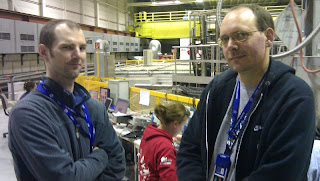
Roy Keyes' (to the left) inexhaustible repository of real life anecdotes helped me to stay awake during the long night shifts at CERN October 2011. Thanks, Roy. Everyone, say hi to Roy...
Common work topics are also Monte Carlo simulations, mostly FLUKA, which UNM is running in the Amazon cloud (awesome idea!). In addition, Roy works on an open source DICOM-RT viewer dicompyler. Dicompyler resembles in many ways my PyTRiP project, which is supposed to be a versatile python visualization tool for the heavy ion treatment planning program TRiP, including a GUI. Probably these projects will merge at some point and take over the world. Again, more on this later.

BTW: You can meet Roy in a little test video I made about the CERN antiproton experiments. Alas, since kdenlive crashes big time in the current version at project loading, I never made it further than the intro and gave up the editing. I'll have to wait until kdenlive is updated in Debian testing repo. But I got looooots of wonderful footage, including details of antiproton production and french speaking technicians fixing dead synchrotrons! :-)

Plenty of plans, only little time, but surely this blog will become much more lively 2011. With these words, I wish you all a happy new year!

Cheers,
Niels

P.S.: Future non-work related blog entries from my side will be published on http://opasnajazona.blogspot.com. (The similarity to a nuclear waste dump is not coincidental.)